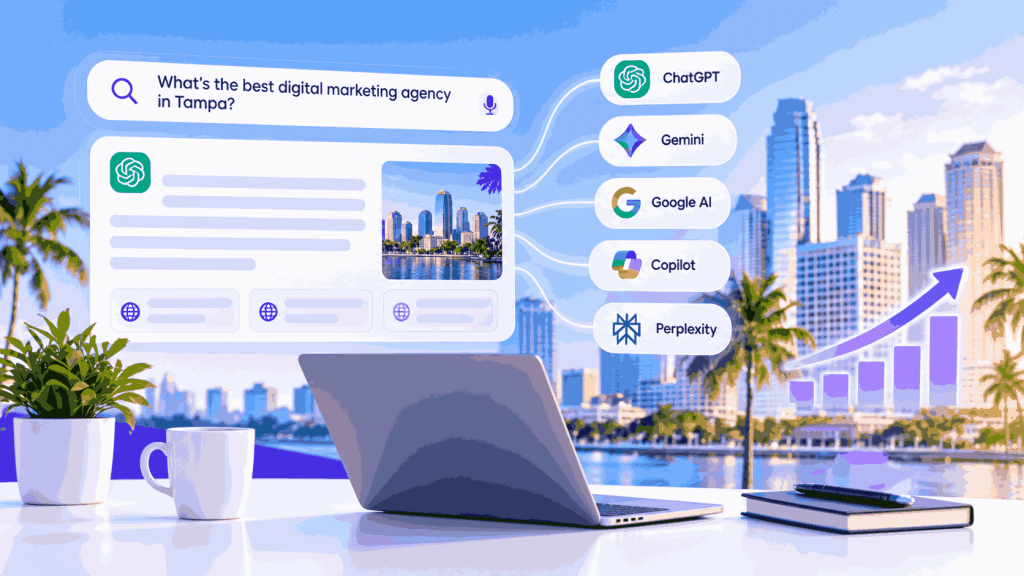
Try this right now. Open ChatGPT, Gemini, or Google and ask: “Who’s the best roofer in Tampa?” or “Recommend a family lawyer in Orlando.” Does your business show up in the answer? If not, someone else is getting that recommendation, and that’s where answer engine optimization comes in.
More and more customers ask AI tools for recommendations instead of scrolling through ten blue links. Answer engine optimization (AEO) is how you make your business easier for those tools to find, understand, and recommend. This guide explains what answer engine optimization is, how it differs from regular SEO, the myths you can safely ignore, and a simple 5-minute test to see where your business stands today. If you’d like expert help, our AI SEO optimization services are built around it.
Table of Contents
- What Is Answer Engine Optimization (AEO)?
- AEO vs. SEO: What’s the Difference?
- What Google Says About AI Overviews (and Why It Matters)
- The 5-Minute AI Visibility Test
- How AI Tools Decide Which Businesses to Mention
- 7 Answer Engine Optimization Steps for Florida Businesses
- Before and After: Rewriting a Page for AI Answers
- AEO Myths You Can Safely Ignore
- What Answer Engine Optimization Looks Like by Industry
- Your 30-Day Answer Engine Optimization Plan
- How to Measure AEO Results
- Frequently Asked Questions About Answer Engine Optimization
- Get a Free AI Visibility Review
What Is Answer Engine Optimization (AEO)?
Answer engine optimization is the practice of making your website and online presence clear, trustworthy, and easy for AI-powered tools to use when they answer questions. These “answer engines” include Google’s AI Overviews and AI Mode, ChatGPT, Gemini, Microsoft Copilot, and Perplexity.
Traditional search shows a list of links. Answer engines often give a direct answer and may mention or link to a few businesses or sources. Answer engine optimization aims to make your business one of them.
In one sentence: SEO helps you rank in search results; answer engine optimization helps you get mentioned in AI-generated answers. In practice, the two overlap heavily.
AEO vs. SEO: What’s the Difference?
| Traditional SEO | Answer engine optimization (AEO) | |
|---|---|---|
| Main goal | Rank high in search results | Be mentioned or cited in AI answers |
| Where it shows up | Google’s results page and Map Pack | AI Overviews, AI Mode, ChatGPT, Gemini, Perplexity |
| What users see | A list of links | A direct answer, often with a few sources |
| Content style | Pages built around keywords | Clear answers to real questions |
| Foundation | Technical SEO, content, links, reviews | The same foundation, plus extra clarity and consistency |
Here’s the good news: answer engine optimization doesn’t replace SEO. It builds on it. Google itself says that the best practices for SEO remain relevant for its AI features in Search.
What Google Says About AI Overviews (and Why It Matters)
There’s a lot of hype around AI search, so it helps to start with what Google has actually published. In its guide to AI features and your website, Google states:
- There are no additional requirements to appear in AI Overviews or AI Mode, and no special optimizations are necessary.
- The best practices for SEO remain relevant for AI features in Google Search.
- You don’t need to create new machine-readable files, AI text files, or special markup to appear in these features.
- There’s no special schema.org structured data you need to add, but your structured data should match the visible text on the page.
That means answer engine optimization is not a secret trick. It’s doing the fundamentals of good SEO exceptionally well, with a sharper focus on clear answers, trust, and consistent business information. Anyone selling you a “magic AI file” that guarantees AI mentions is overselling.
The 5-Minute AI Visibility Test
Before you change anything, find out where you stand. Grab a notepad and try these prompts in ChatGPT, Gemini, and Google (look for an AI Overview at the top). Replace the brackets with your details:
- “Who are the best [your service] companies in [your city]?”
- “Recommend a [your service] near [your neighborhood or city].”
- “What is [your business name]?”
- “Is [your business name] a good choice for [your service]?”
- “How much does [your service] cost in [your city]?”
Now score yourself:
| What you see | Score |
|---|---|
| Your business is named and described correctly | 2 points per prompt |
| Your business is mentioned, but details are wrong or vague | 1 point per prompt |
| Your business isn’t mentioned at all | 0 points |
8–10 points: You’re in good shape. Keep strengthening your reviews and content.
4–7 points: You show up sometimes. The steps below can help close the gaps.
0–3 points: AI tools don’t know much about you yet. That’s common, and fixable.
AI answers change often and can differ from person to person, so treat this as a quick snapshot, not a final verdict. Want a second opinion? Send us your results, and we’ll include them in a free review (details at the end of this post).
How AI Tools Decide Which Businesses to Mention
No AI company publishes a full recipe, but the patterns are consistent with how search has always worked. AI tools tend to favor businesses and pages that are:
- Easy to find and crawl: Pages that search engines can access, index, and understand.
- Clear: Content that answers specific questions directly, in plain language.
- Trustworthy: Businesses with real reviews, accurate details, and a solid reputation across the web.
- Consistent: The same name, address, phone number, and services everywhere online.
- Relevant and local: Information that matches the question, including the city or area.
For local businesses, Google’s own explanation of how local ranking works points to relevance, distance, and prominence. Those same signals help your business show up when people ask AI tools for local recommendations through Google.
7 Answer Engine Optimization Steps for Florida Businesses
1. Answer Real Questions, Clearly and Early
Start every important page with a short, direct answer before going into detail. If someone asks “How long does a roof replacement take in Florida?”, the first two sentences of your page should answer exactly that.
Build a list of the questions your customers ask on the phone, in emails, and during consultations. Each one is a potential section, FAQ, or blog post. This is the heart of answer engine optimization.
2. Use Question-Based Headings and FAQ Sections
Headings like “How much does kitchen remodeling cost in Tampa?” or “Do I need a lawyer after a minor car accident in Florida?” match the way people talk to AI tools. Add a short FAQ section to key service pages, and keep each answer focused.
If you use FAQ schema, make sure it matches the visible text on the page, as Google recommends.
3. Make Your Business Information Consistent Everywhere
AI tools pull from many sources. If your phone number, hours, or services differ between your website, Google Business Profile, Facebook, Yelp, and directories, AI answers may be vague or wrong.
Audit your listings and fix inconsistencies. Keep your Google Business Profile complete, with accurate categories, services, hours, photos, and a clear description. Our local SEO guide for Florida businesses walks through the basics.
4. Earn Detailed, Genuine Reviews
Reviews help both rankings and trust. Detailed reviews that mention the service and location, such as “They replaced our roof in Brandon after the storm,” give AI tools and customers useful context.
Ask every happy customer for a review, respond to every review professionally, and never buy or fake reviews. Simple workflow automation can send review requests automatically after each job or case.
5. Show Real Expertise and Experience
Answer engines and searchers both value content that clearly comes from people who know the subject. Google’s guidance on creating helpful, reliable, people-first content emphasizes showing experience and expertise.
Add detailed team or attorney bios, licenses and certifications, years in business, real project photos, and case studies. Write about local specifics, such as Florida hurricane season, county permit processes, or state-specific rules, that generic national sites can’t cover well.
6. Keep Your Website Technically Healthy
AI features in Google Search rely on pages that are indexed and eligible to appear in search. Basic technical health matters:
- Pages load quickly on mobile.
- Important content is written in text, not hidden in images.
- Search engines can crawl your key pages.
- Internal links connect related pages.
- Structured data matches what’s visible on the page.
A modern AI-optimized WordPress website or custom website makes these basics easier, and ongoing maintenance and support keeps them in place.
7. Build Mentions Beyond Your Own Website
AI tools often learn about businesses from across the web, not just from your site. Mentions in local news, industry associations, chambers of commerce, supplier directories, podcasts, and community sponsorships help establish your business as a recognized local name.
Focus on genuine, relevant mentions rather than bulk link schemes, which can hurt more than help.
Before and After: Rewriting a Page for AI Answers
Seeing the difference makes answer engine optimization much easier to understand. Here’s a typical opening paragraph on a contractor’s service page:
Before: “Welcome to ABC Roofing! We are your trusted partner for all your roofing needs. With years of experience and a commitment to excellence, we deliver quality results you can count on. Contact us today!”
It sounds friendly, but it doesn’t answer anything. An AI tool can’t tell what services the company offers, where it works, or what makes it different.
After: “ABC Roofing replaces and repairs shingle, tile, and metal roofs for homeowners in Tampa, Brandon, and Riverview. Most roof replacements take one to three days, depending on size and weather. We’re a licensed Florida roofing contractor, and we help homeowners document storm damage for insurance claims.”
The second version answers who, what, where, how long, and why in four sentences. It’s more useful for customers, easier for search engines to understand, and more likely to be quoted in an AI answer. (ABC Roofing is a made-up example.)
Try this with your own homepage and top three service pages. It’s one of the fastest answer engine optimization wins available.
AEO Myths You Can Safely Ignore
There’s plenty of confusing advice about answer engine optimization. Here are common myths and what’s actually true:
| Myth | Reality |
|---|---|
| “You need a special AI file to appear in AI Overviews.” | Google says you don’t need new machine-readable files or AI text files. |
| “There’s secret schema just for AI.” | Google says there’s no special schema.org markup required for AI features. |
| “SEO is dead because of AI.” | Google says SEO best practices remain relevant for its AI features. |
| “Someone can guarantee you’ll be recommended by ChatGPT.” | No one controls what AI tools say. Be wary of guarantees. |
| “AEO is only for big brands.” | Local businesses with clear content and strong reviews can stand out in their area. |
What Answer Engine Optimization Looks Like by Industry
Every industry gets asked different questions. Here’s how answer engine optimization might look for common Florida businesses:
- Contractors and home services: Pages that answer “How much does a new roof cost in Tampa?” or “What should I do after hurricane damage?” Our guides to contractor SEO in Florida and contractor marketing cost show this approach in action, and our contractor marketing agency team can put it to work for you.
- Law firms: Clear explanations of common legal questions, written with attorney review and Florida Bar advertising rules in mind. See our Florida law firm SEO guide and law firm marketing agency services.
- Medical and wellness clinics: Plain-language answers about services, insurance, and what to expect at a first visit.
- Restaurants and retail: Accurate hours, menus, specialties, and location details across every platform.
- Professional services: Pages that explain your process, pricing factors, and who you help best.
If you’re comparing agencies to help with this, our guide on how to choose a marketing agency in Tampa gives you 12 questions to ask, and our Tampa marketing agency page shows how we work with local businesses.
Your 30-Day Answer Engine Optimization Plan
Want a simple starting point? Follow this plan for one month:
Week 1: Check and clean up
– Run the 5-minute AI visibility test and save your results.
– Fix inconsistent business details on your website and major listings.
– Complete every section of your Google Business Profile.
Week 2: Answer questions
– List your 20 most common customer questions.
– Add direct answers and FAQ sections to your top three service pages.
Week 3: Build trust
– Update team bios, licenses, and credentials.
– Ask recent customers for detailed reviews.
– Add real photos and at least one case study.
Week 4: Expand and measure
– Publish one helpful article that answers a common local question.
– Repeat the AI visibility test and compare your scores.
– Check Google Search Console for new queries and impressions.
Answer engine optimization is ongoing. Repeat the test every month or two to track progress.
How to Measure AEO Results
AI visibility is harder to measure than traditional rankings, but you can still track progress:
- Repeat the AI visibility test monthly and compare your scores.
- Watch Google Search Console for growth in impressions, especially for question-style searches.
- Ask new customers how they found you, and add “AI tool, like ChatGPT” as an option on intake forms.
- Track calls and form submissions so you can connect visibility to real leads.
- Monitor your Google Business Profile insights for calls, website clicks, and direction requests.
An AI chatbot or assistant on your site can also capture visitors who arrive from AI tools after hours, so new interest turns into real conversations.
Frequently Asked Questions About Answer Engine Optimization
Is answer engine optimization different from SEO?
They overlap heavily. SEO focuses on ranking in search results, while answer engine optimization focuses on being mentioned in AI-generated answers. Google says SEO best practices remain relevant for its AI features, so strong SEO is the foundation of AEO.
Can I pay to appear in ChatGPT or Google AI Overviews?
Organic AI answers can’t be bought. You improve your chances by making your business clear, trustworthy, and consistent across the web. Be cautious of anyone who guarantees AI placements.
Do I need a new website for AEO?
Not necessarily. Many businesses can improve their existing pages with clearer answers, better structure, and stronger trust signals. A rebuild makes sense if your site is slow, outdated, or hard to update.
How long does answer engine optimization take?
Some improvements, like fixing business details and adding FAQs, can be done quickly. Seeing changes in AI answers can take weeks or months, and results vary. No one can guarantee when or whether a specific AI tool will mention your business.
Is AEO worth it for small local businesses?
Yes. Local businesses often have an advantage because AI tools look for relevant, location-specific answers. Clear local content and strong reviews can help a small business stand out in its area.
Get a Free AI Visibility Review
Customers are already asking AI tools who to hire. The question is whether your business is part of the answer.
Anzo Solutions is a digital marketing agency in St. Petersburg, Florida, helping businesses across Tampa Bay and Florida get found in search and AI tools. Send us your 5-minute test results, or let us run the test for you. We’ll review how AI tools and Google currently see your business and share a clear action plan, with no obligation. Request your free AI visibility review, contact our team, or call +1 (786) 954-7406. You can also explore our AI SEO optimization services, learn more about us, or browse our case studies.
Disclaimer: This article is for general informational purposes only. AI tools and search engines change frequently, and no one can guarantee that a business will appear in AI-generated answers or search results. Results vary.